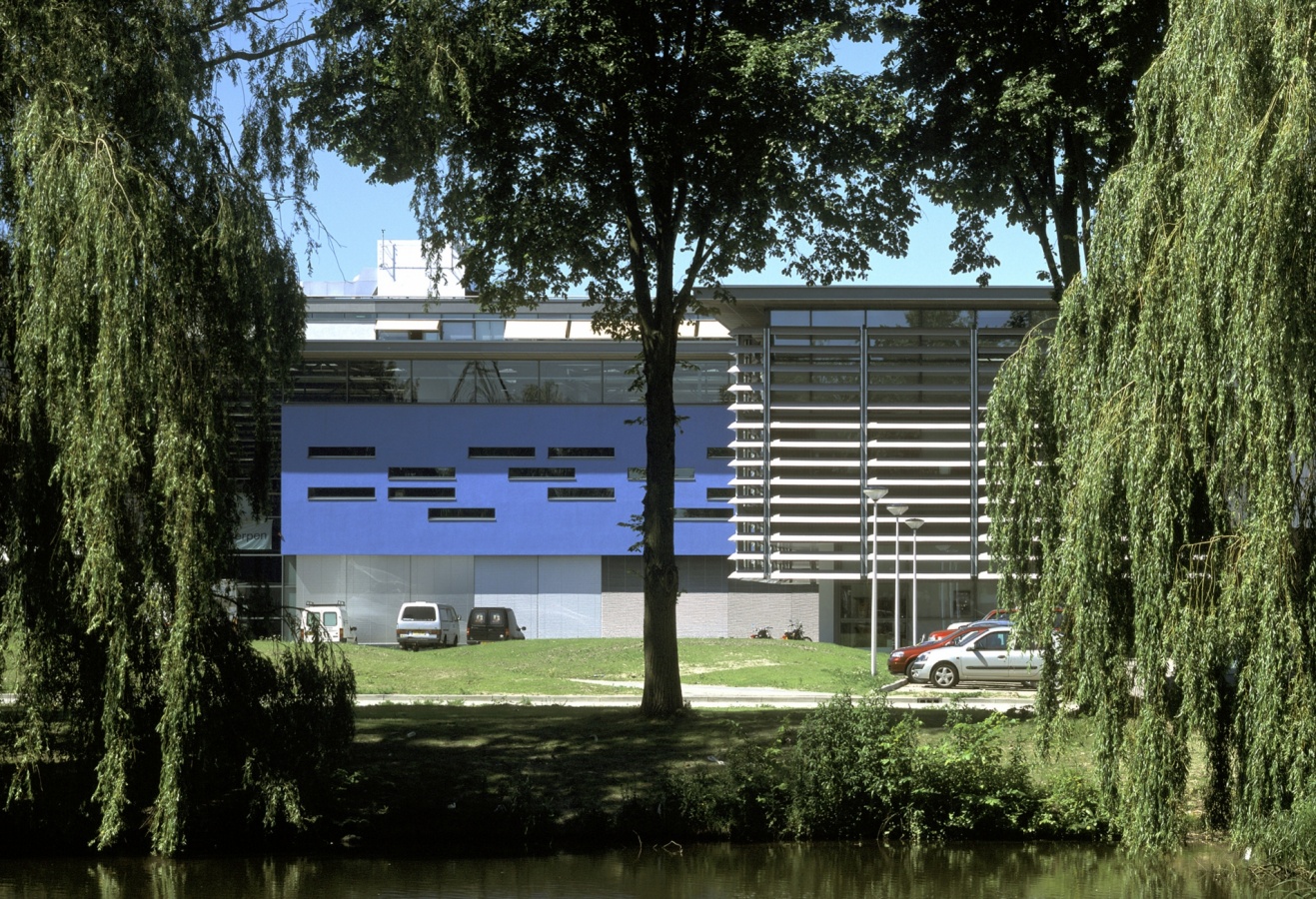
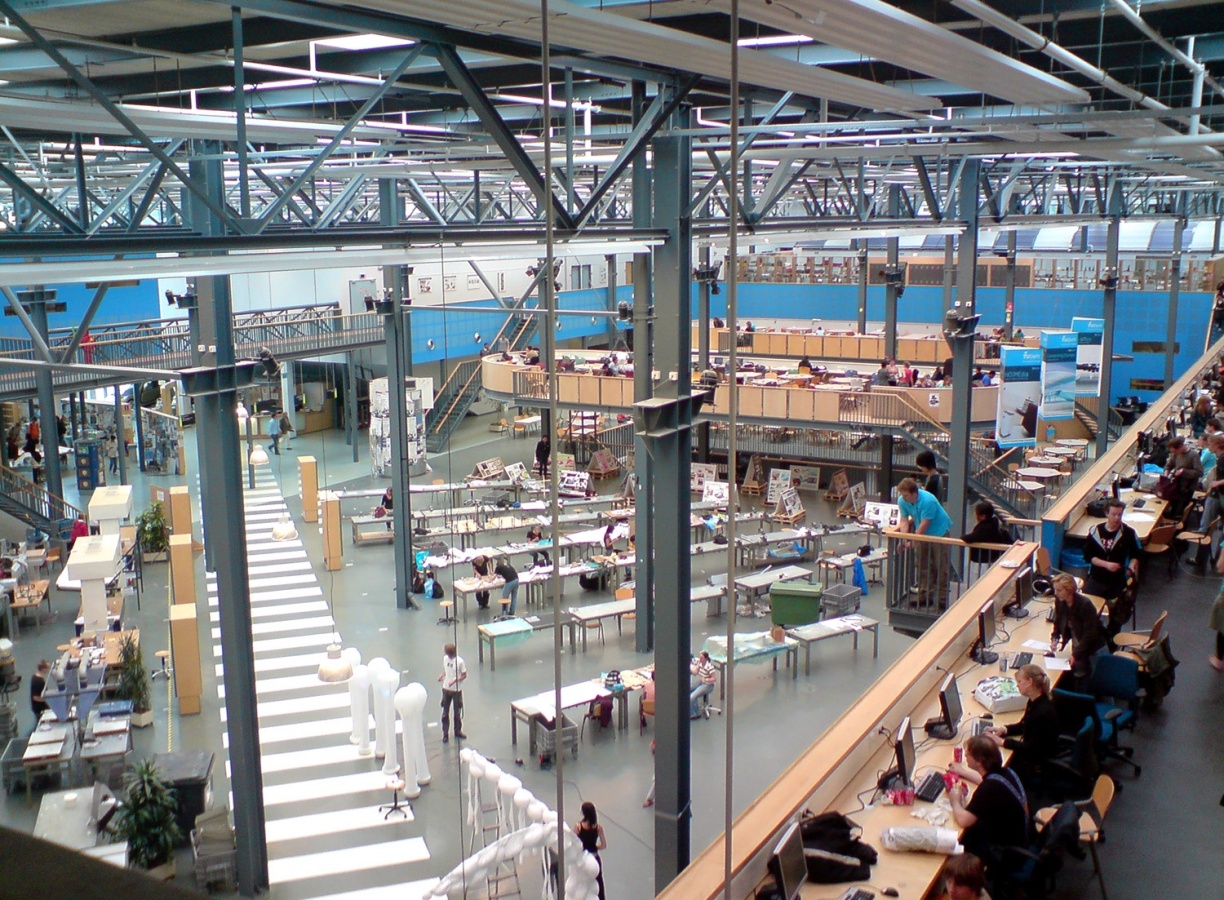
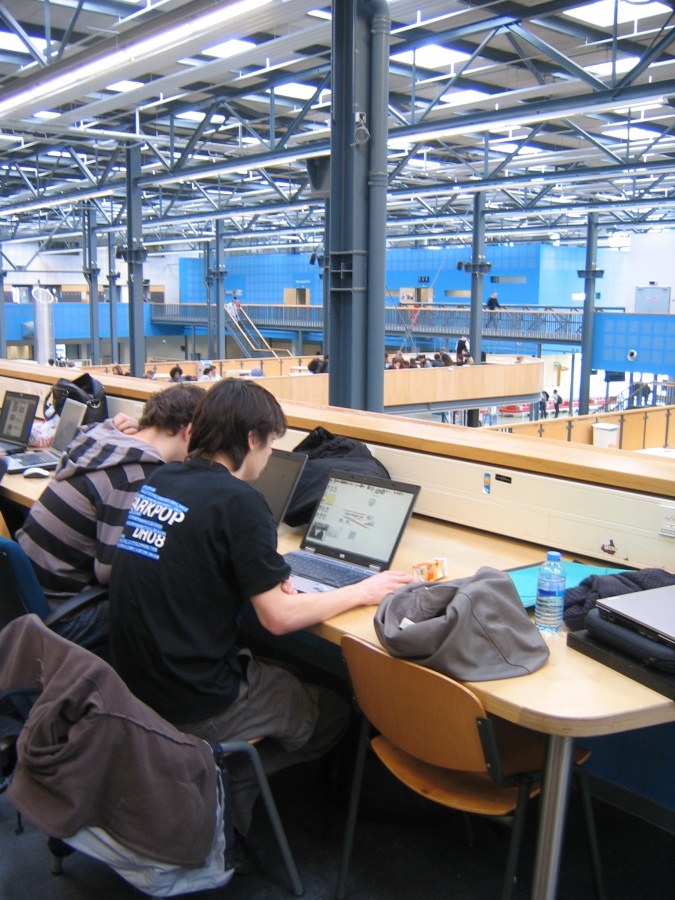
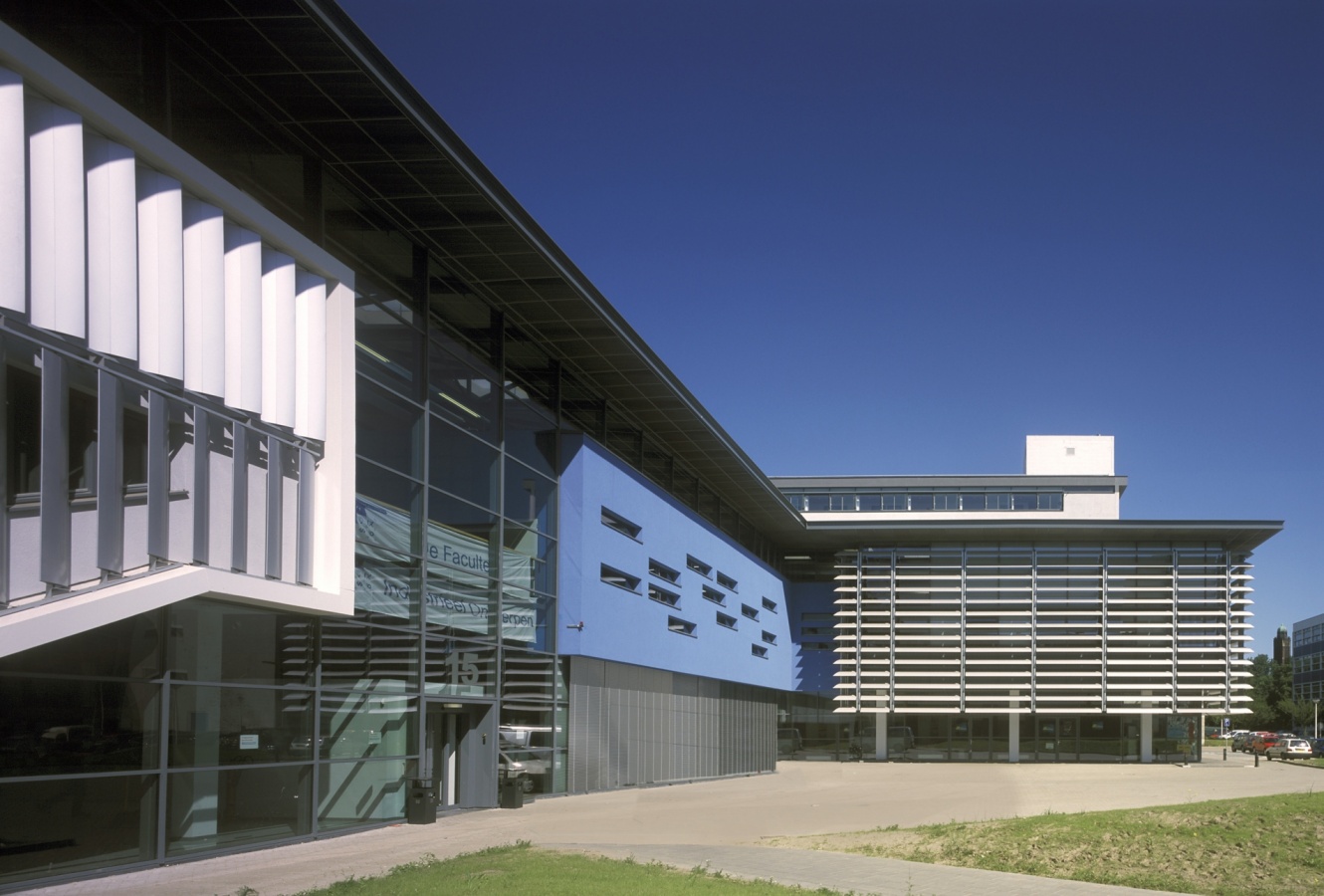
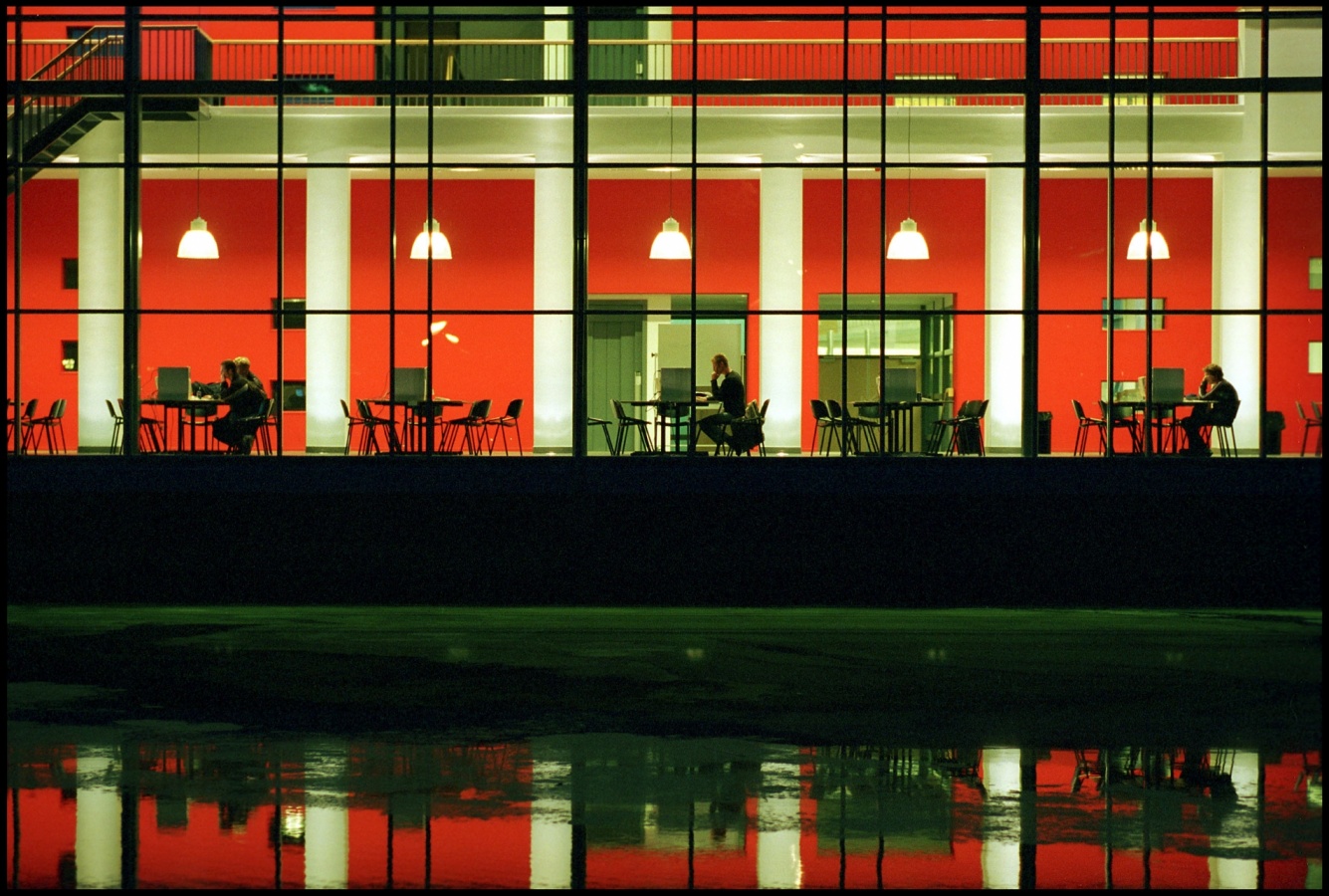
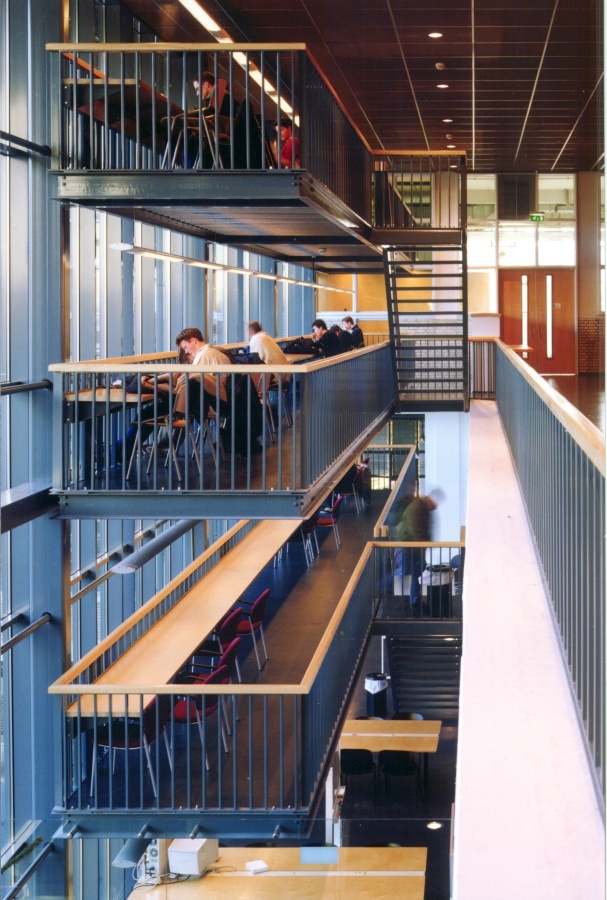
The new faculty OCP of Delft university of technology, accommodates the disciplines of Mechanical, Maritime and Industrial Design. During the constructionworks school continued. The new building shows a contemporary, logical and efficient architectural structure with it's own recognizable facade in the TU-district. The interior design is executed as an integral part of the whole plan.
| Status | completed 2002 |
| Architects | Fons Verheijen, Krijn Tabbers |
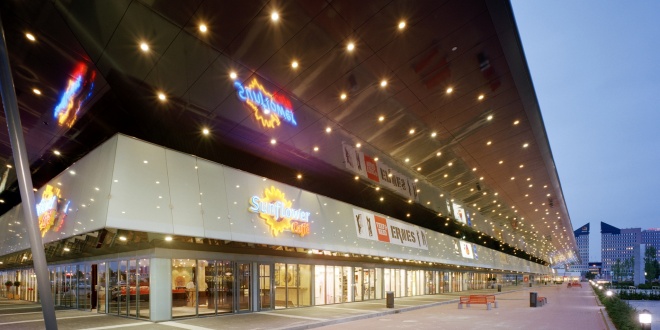
For the large-scale shopping and business center De Herven, dating from 1979, there was a threat of emptying out and impoverishment, including through screaming facade advertising. A redevelopment plan was implemented in 2003 to reverse this negative spiral. With important but relatively simple interventions, such as a uniform facade layout and advertising to be conducted according to fixed rules, as well as a generous continuous and cantilevered awning of 13 meters, a high-quality and pleasant residential area has again been created. The immediate surroundings, the walking area and the parking lot, have also been redesigned and constructed.
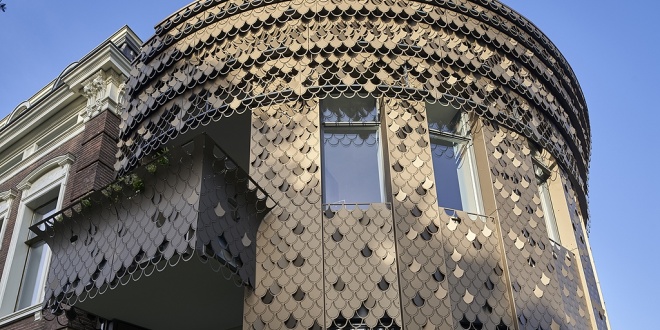
The Plantsoen in Leiden is well known for the historical appearance of both the city park (1836) and the houses of the last quarter of the 19th century. The park was originally landscaped on the edge of the city in the place of an old defense belt. At the entrance of the park at the east side the monumental building Plantsoen 1 – 3 is redeveloped in a complex with 6 apartments. The apartments of about 150 m² are provided with all luxury and comfort, such as a private indoor garage, spacious roof terraces and an elevator, while retaining the historical look and value of the building. Redevelopment also applies to sustainability; obtaining Energy label A. Exterior facades, window frames and roof are additionally insulated. The houses are underfloor heated and solar panels are provided on the roof.
The municipal monument at Plantsoen 1 – 3 is divided over three floors and a basement. The property at number 1 was originally a fully detached house, number 3 was part of a block of 3 houses. Both buildings date from 1875 and were connected in 1957 and converted into one large nursing home. In this function change, the original qualities have largely been lost. The round expansion at number 1 dates from 1993.
In the new layout with 6 apartment, the monuments are restored to their former glory by restoration contractor Burgy from Leiden. The façade of the intermediate building is renewed and aligned with the monuments. The existing façade of the round building is finished with a bronze wall cladding, a ‘veil‘ with a leaf motif. This pattern is inspired by the leaf motifs and decorations of the 19th century, which can still be found in various places along the Plantsoen. The round with ‘veil’ becomes a special recognition point in the inner city.
Each apartment has both rooms in the monumental area as well as in the newer parts. The interior of the monumental buildings is provided with appropriate details to bring back the historical character as much as possible. This specific part is provided by Verlaan & Bouwstra architects from Vianen.
On the inside buyers have a lot of freedom of choice; they can choose for an even richer historical finish with wall tension, panelling and en-suite layout or a tight, modern finish and layout; both are possible. Each apartment is unique, has its own layout and its own character. Only the view is the same for all apartments; they all look out over the beautiful monumental city park the Plantsoen at the town canal.
The redevelopment was completed in July 2018.
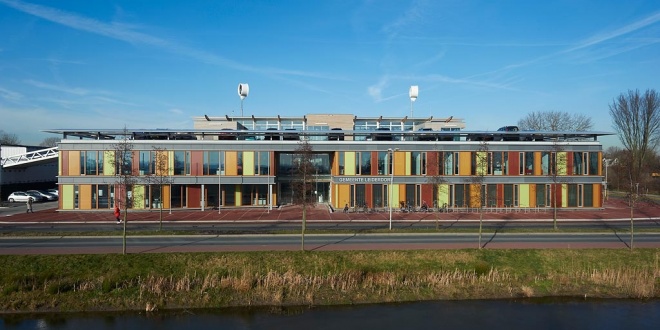
This colourfull, functional and energysaving design fully provides in the requirements and ambitions of the Leiderdorp municipality. In 2008 the municipality decided to build a new town hall and was tendered as a design & build contract. Together wit Dura Vermeer Vastgoed, VVKH won the competition. They chose a two-storey building with an atrium and parking on the roof. The atrium forms a vivid space for employees and visitors. This is also where the public counters are situated.
The new town hall is a very sustainable building. In the design we took the whole lifecycle in analyses. The result is very comfortable spaces, environment friendly materials and extremely low energy use. Using renewable energy, this building is CO2 neutral.
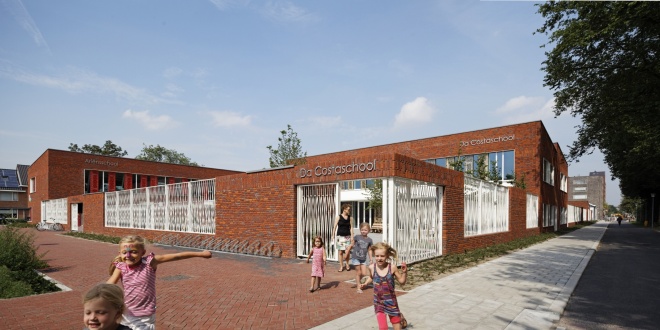
At the Duurstedelaan in Utrecht lies one of the most sustainable schools of the Netherlands. The school is centrally located in a reviving neighbourhood, in the south of Utrecht and accommodates three primary schools, a nursery and a broad programme of functions related to the school and local community. Future users participated from the start in the design-process. Different users gain with collaboration, but also want to be recognized and have their own specific needs. All functions are organised round a collective court space. The gym is constructed above this space and thus forms the roof of the court. The building is set up in red brickwork that is continued in the playground boundaries. The identity of the different schools is reflected in their own colour and pattern in het façade panelling and silhouette of the building-mass. The whole setup matches with the urban scale of the neighbourhood and blends in naturally.