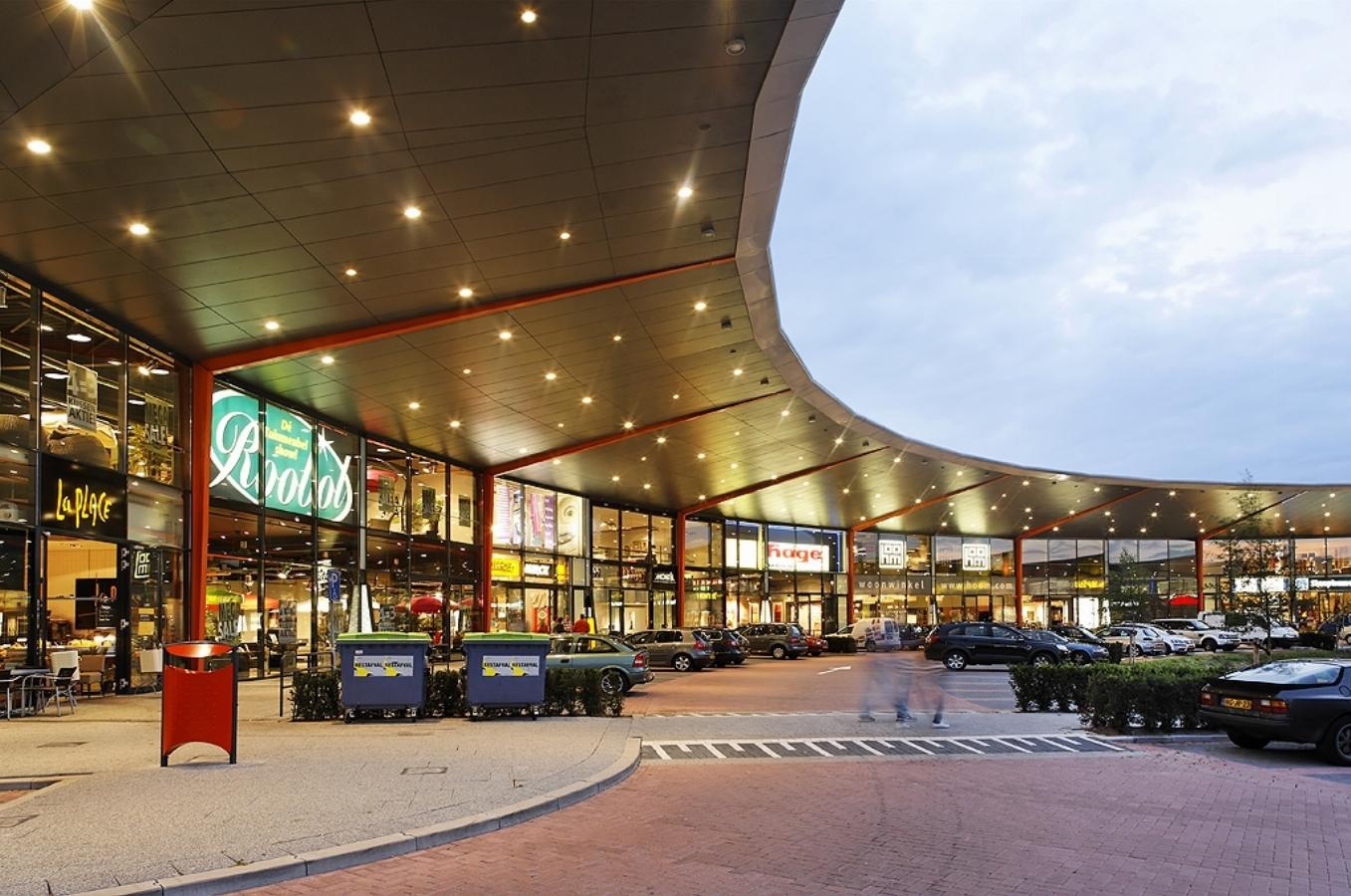
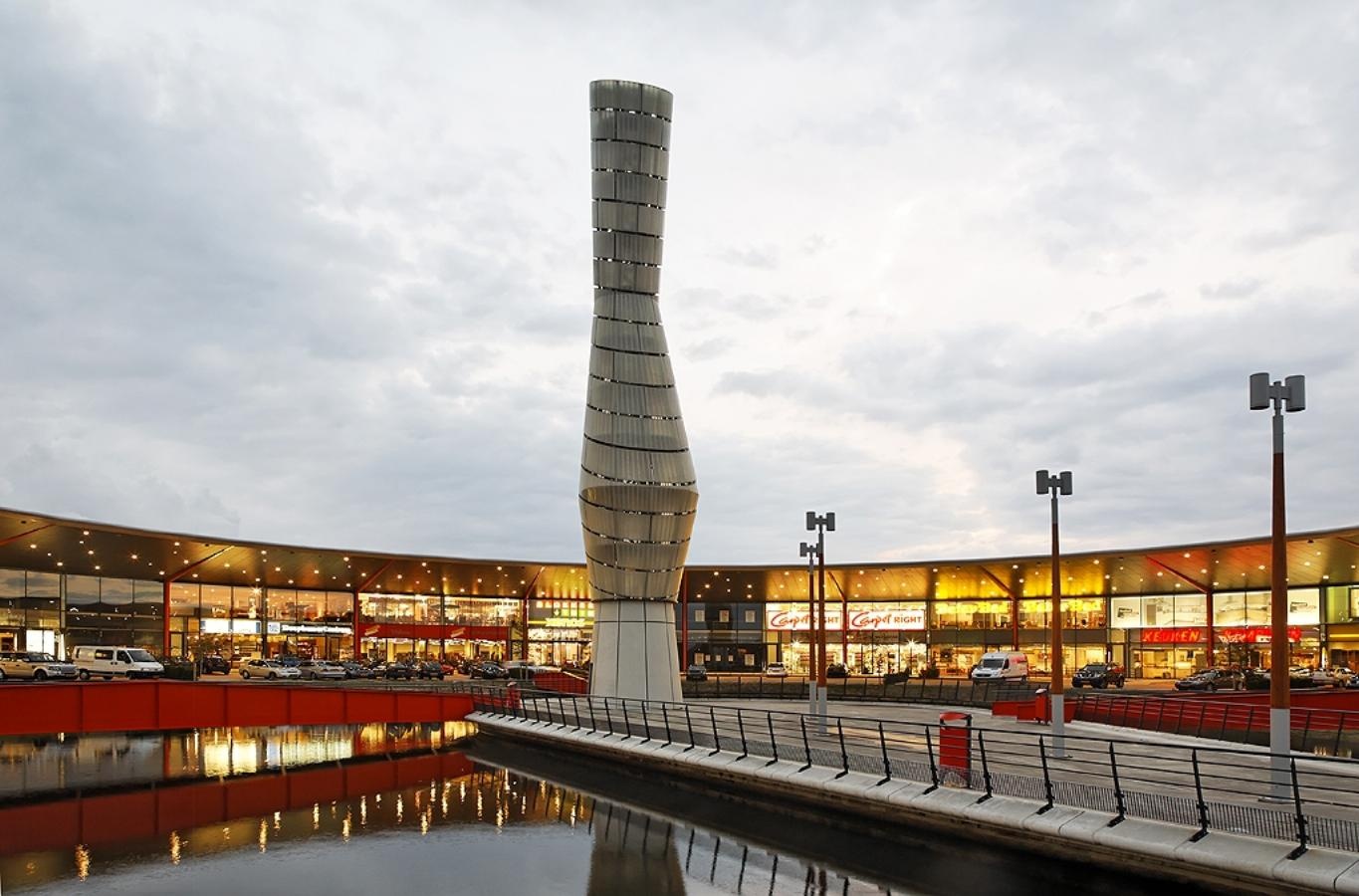
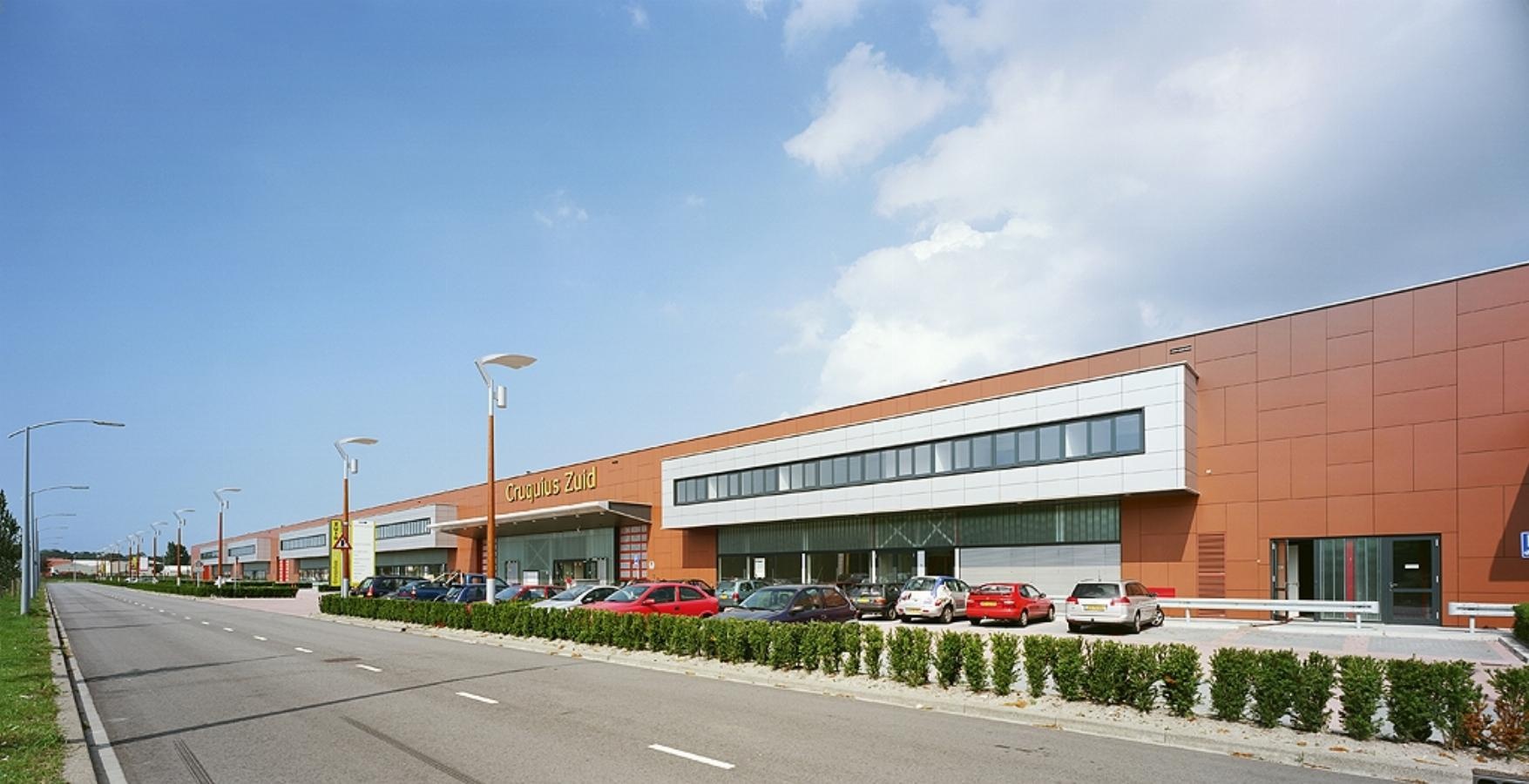
Cruquius Plaza, near Hoofddorp, municipality of Haarlemmermeer is the result of a competition that was organized in 1999 on behalf of the municipality of Haarlemmermeer to boost shopping in Cruquius. The competition was won by ING Vastgoed and VVKH. The existing residential boulevard has been completely renovated and adapted to the requirements of today. In addition, 30,000 m2 of retail space and 25,000 m2 of industrial space have been added. A flexible building, particularly with regard to the shops, and a water feature with a square at the shop entrances have been realized at the location. The cantilevered awning offers provides shelter for a pleasant shopping climate. The supply takes place from two expedition entrances on the company side. Via the internally located expedition corridors on the ground floor and first floor, the shops can be supplied freely from the shoppers. The 30-meter-high Cruquius Tower, the luminous center of the square, is a clear landmark of the residential boulevard.
| Architects | Fons Verheijen |
| Client(s) | ING Vastgoed |
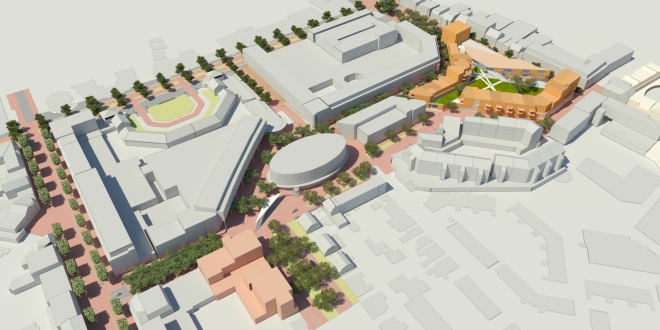
The urban plan for the city-centre of Zeist provides for necessary architectural interventions, but is mainly concerned with the quality of public space. Identified characteristics of Zeist have been projected on the city centre. By doing this the centre will be much greener and facades will be restored to what they used to look like. The urban plan defines three different shoppingzones, each with their own atmosphere and type of shops. By banning cars a continuous and compact shopping area with pleasant pedestrian streets emerges.
A big part of the urban plan is the redevelopment of the library. VVKH aims to reuse the building as much as possible. The building is less than 30 years old and apart from the closed facades it functions well. In the new design we make shoppingfacades on the ground floor, moving the library to a new part of the building. On top we planned 58 apartments with a shared garden. Reuse of the existing building may demand an extra effort, but offers a very sustainable sollution and saves on investments.
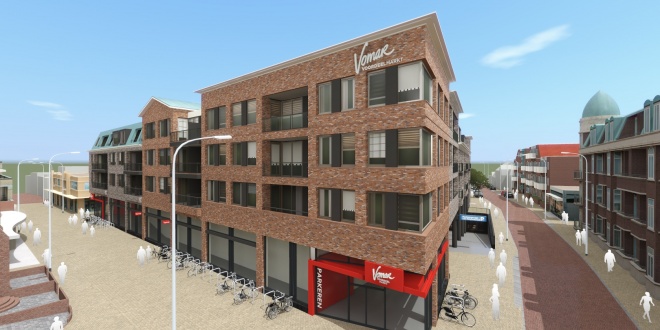
Urban development and architectural integration “Vomar” location, corner of Abraham van Rooijenstraat and Maarten Kruijtstraat in Noordwijk
From an urban planning point of view, the contours and height of the building plan were determined by the municipality of Noordwijk. The plan clearly defines the streets Abraham van Rooijenstraat and Maarten Kruijtstraat, in line with the existing street profiles. Gasthuissteeg will also have a clear boundary with this building plan.
The main mass has an intermediate scale between two worlds present in the environment. On the one hand, there is the smaller-scale village development of the Hoofdstraat and on the other hand, the large-scale hotel development. The mass of the new building block to be built is 3 storeys high plus a roof storey. It is articulated into a number of volumes, softening the scale of the building block. These volumes are made independent by different colors of masonry and roof finishes. With a play of rhythm between balconies, windows, tires, roof moldings and a green-copper-colored roof, the building blends in well with the seaside resort architecture of the environment. The mass on the Gasthuissteeg is 2 storeys high. It has a green facade with window openings. On the north side of the plan, the existing firebreak will be closed and the buildings will close directly on the adjacent plot.
The plan is mainly sustainable because of the triple land use. The building block has an underground floor, on top of that a storey layer, above that a parking deck for the houses and 42 houses.
Abraham van Rooijenstraat is an important access road. That is why functions such as the entrance to the underground parking garage, the entrance to the parking deck on the 1st floor in front of the houses, and the entrance to the expedition have been made here. The Kruisstraat will become more traffic-calmed. This will be the world of shopping as it is at the Hoofdstraat. This is where the shopping functions will be located, which are accessed via two clear entrances at the corners. These entrances are clearly visible from the Hoofdstraat and from the Grent.
The entrance to the houses is on the north side. This will give the existing loading and unloading yard, where other residential accesses are located, a quality impulse. The gallery facade, which is hardly visible from the public space, is conceived as a veranda world. It's a light world of painted wood.
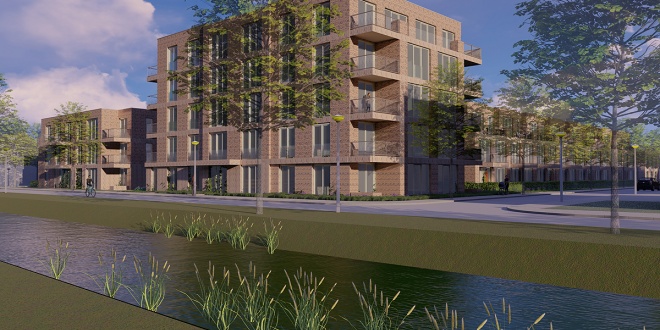
Housing association St. Willibrordus wants to renew 40 duplex houses along Stompwijckstraat in Wassenaar. The program provides for the realization of 86 social rental homes, mainly for starters and seniors. The plan area is located in a village extension from the 1960s. At the time of completion, this was the northernmost district of Wassenaar and it overlooked the meadows and farms. The district is spacious with a focus on greenery. In the development of the plan, we link up with the basic qualities of the neighborhood with spacious profiles with front gardens and lots of greenery. In order to be able to make the closed building block, the Stompwijckstraat in between will be removed. This provides space to solve parking for residents within the building block. The plan also provides for a communal courtyard with a social facility adjacent to it.
To create privacy in the front gardens, we create a green strip between the front gardens and the sidewalk that remains the property of the municipality. The existing structure of mature trees will be maintained. There is a distinction between a formal front, with zoom houses on the ground floor all around that are accessible from the street side, and an informal rear with parking under an open green deck (through which existing large trees protrude) and the access to the houses on the upper floors. through wide galleries. In the long streets, the building blocks match in scale with the buildings on the overlying because the top (third) storey has a setback in relation to the building line. On three sides of the building block, the balconies of the houses on the upper floors hang from the building blocks as ornaments. The balconies provide contact with the street and respond to the orientation with respect to the sun by means of a rotation and still show the echo of the current situation. The building block responds somewhat more robustly to the northern park side. On the northwest side, one of the blocks reacts in height to the adjacent apartment building.
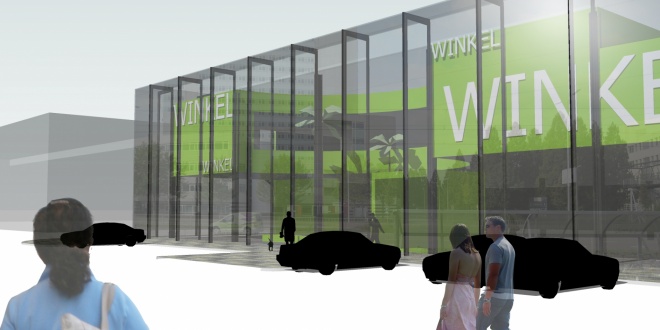
Commissioned by Bouwfonds REIM, VVKH has made a design for a distinguishable new shoppingbuilding. The new building is facing a main road entering Utrecht and acts as a showcase for the home and living stores in the streets behind. The plan consists of the demolition of an outdated officebuilding and construction of the new building with several shops showing a transparant facade towards the Europalaan.