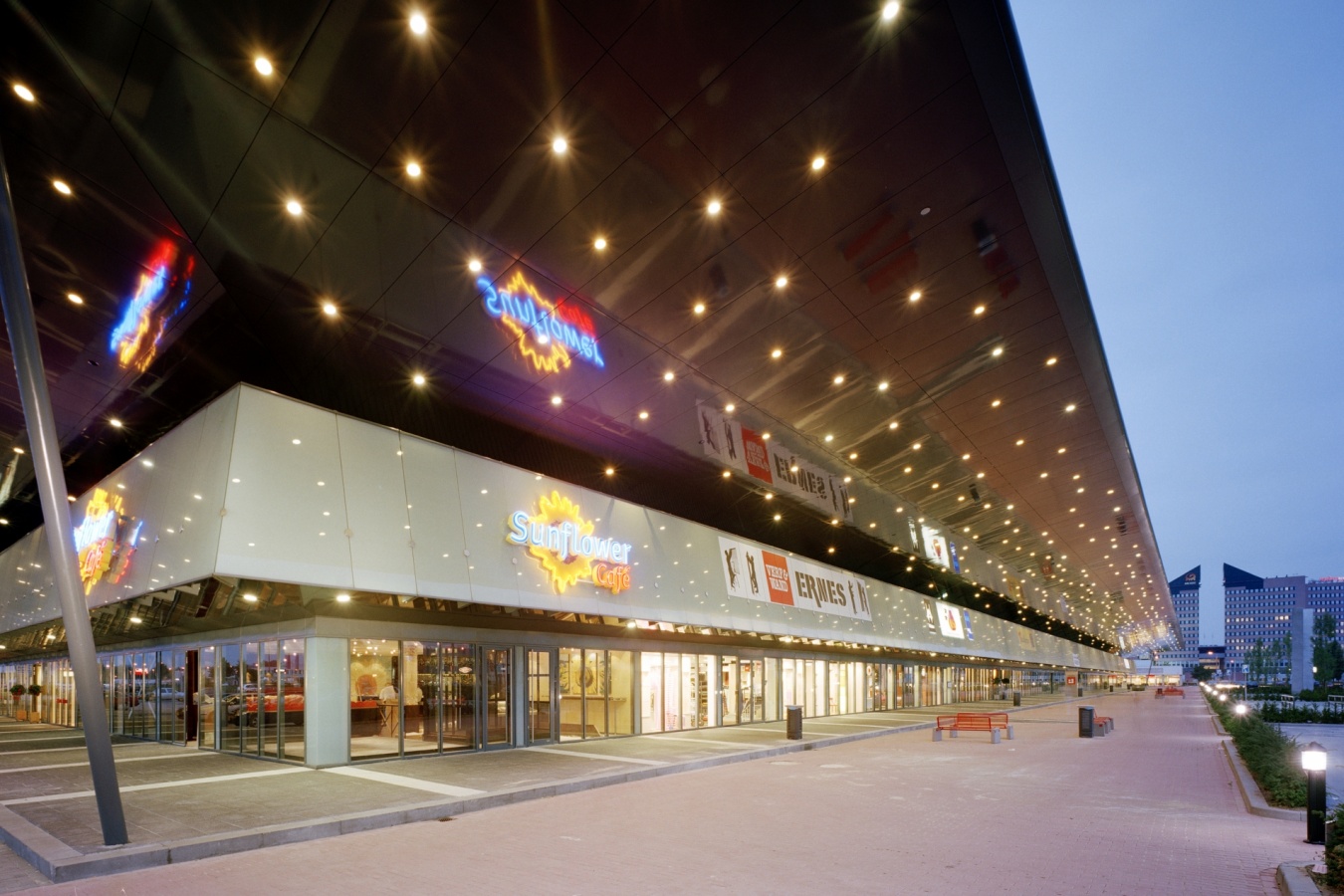
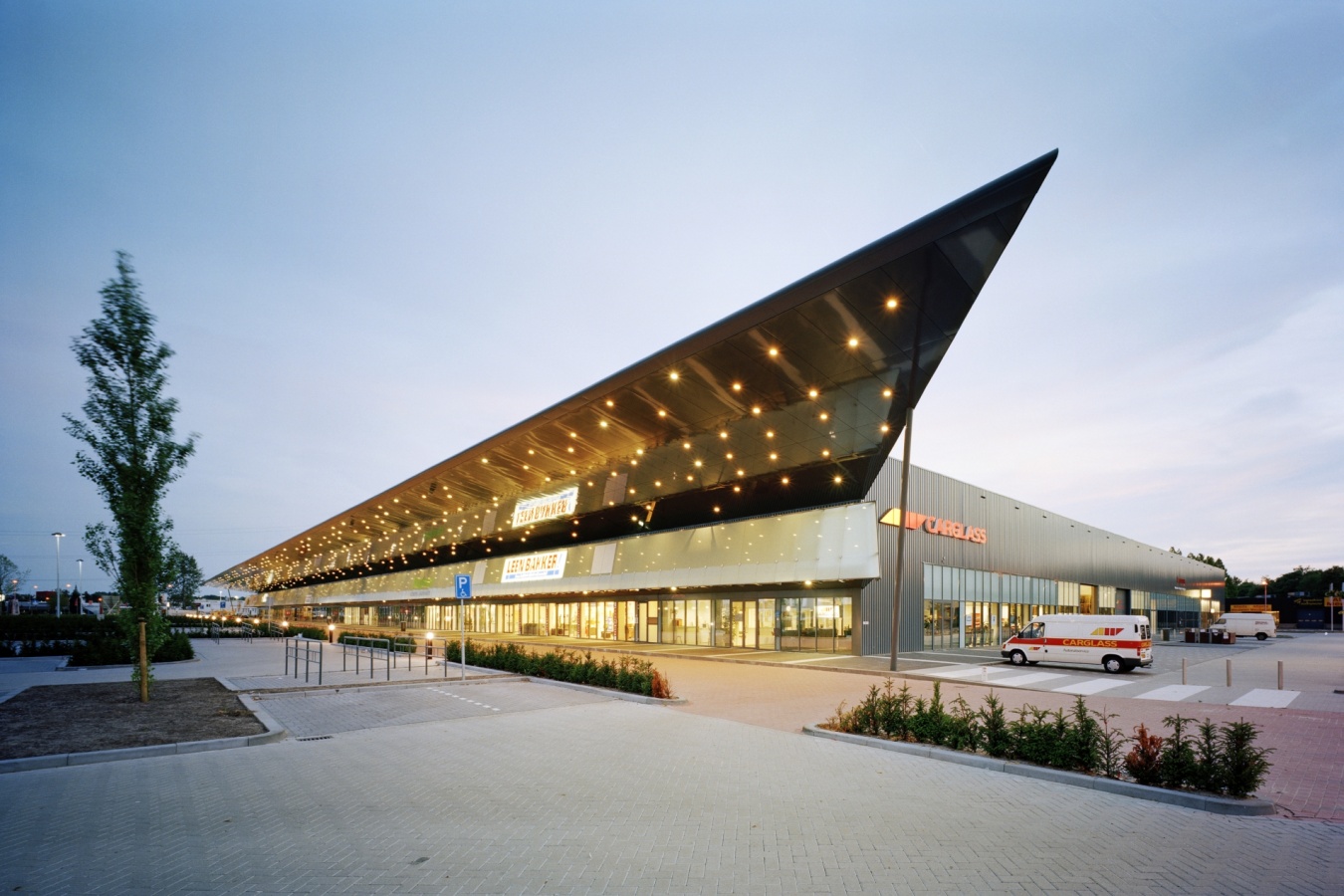
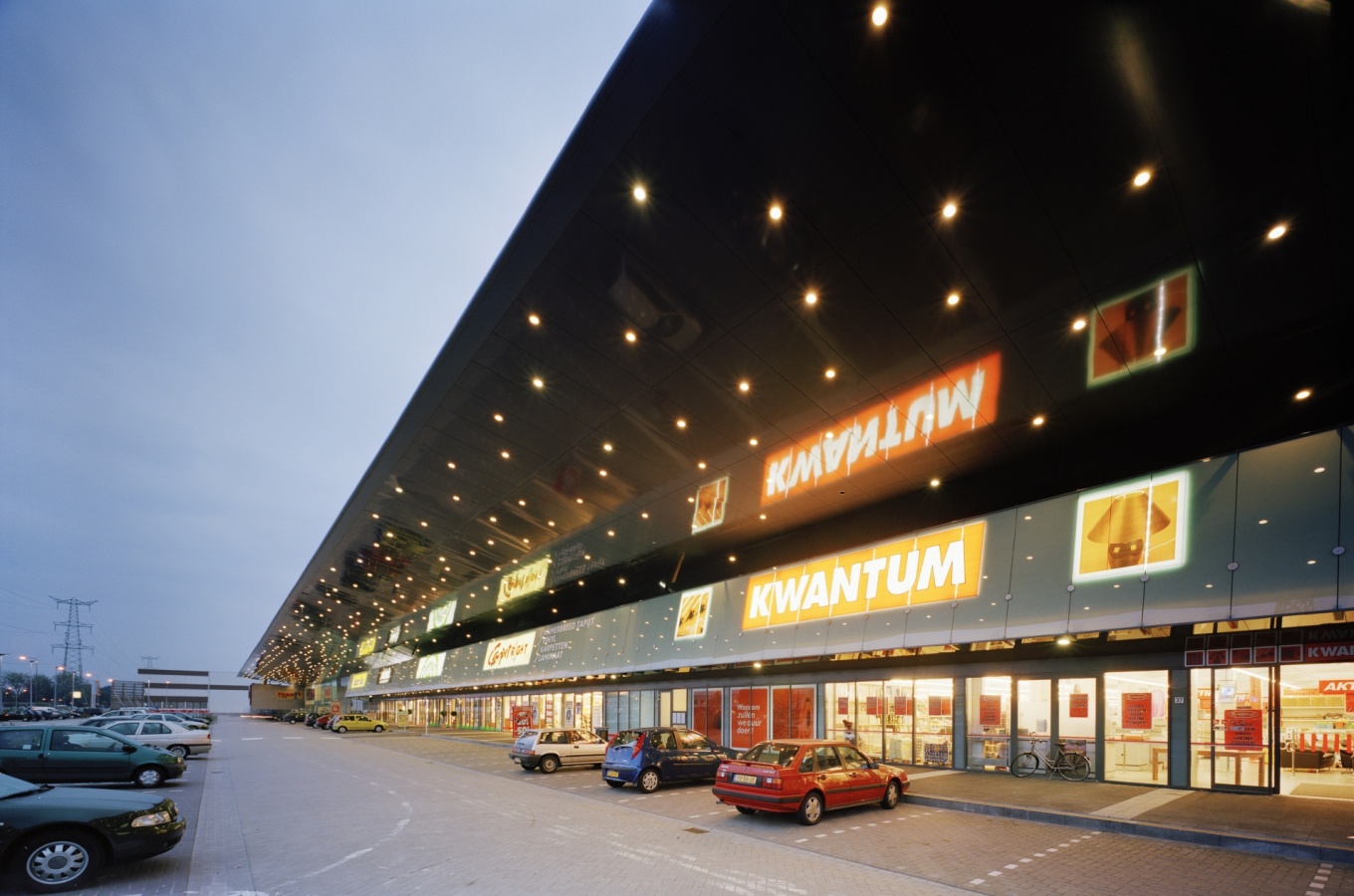
For the large-scale shopping and business center De Herven, dating from 1979, there was a threat of emptying out and impoverishment, including through screaming facade advertising. A redevelopment plan was implemented in 2003 to reverse this negative spiral. With important but relatively simple interventions, such as a uniform facade layout and advertising to be conducted according to fixed rules, as well as a generous continuous and cantilevered awning of 13 meters, a high-quality and pleasant residential area has again been created. The immediate surroundings, the walking area and the parking lot, have also been redesigned and constructed.
| Architects | Fons Verheijen |
| Client(s) | Rodamco Europe |
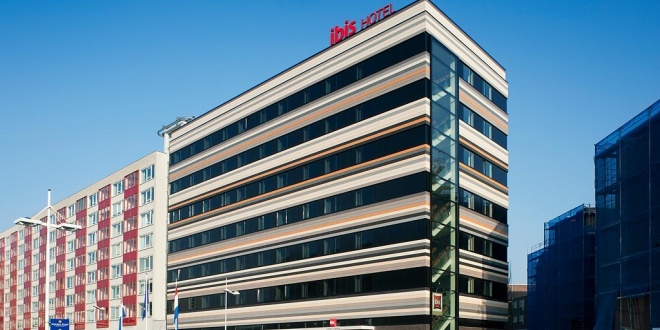
The former university building at the Stationsweg, has been renovated and expanded into a 118-room economy hotel. It is the first franchise hotel of all 870 Ibis hotels in the world and the first Ibis hotel according to the new Ibis generation formula. The new hotel is located opposite Leiden station and is clearly visible from the railway and station.
The 60s building has a completely new facade. The horizontality of the original facade has been enhanced even more in the new facade by providing the parapets of all floors with relatively narrow bands of ceramic elements, placed in varying colors. The black frames and cladding are fitted with a deep gap in relation to the ceramic elements. This makes the colorful horizontal ceramic elements iconic. The facade is continued above the roof. The high, slightly recessed eaves provides a clear termination and also shields the installations on the roof. The plinth of the building is made of a robust stone and a lot of glass. Together with the long white stately canopy of light concrete, they form the basis for the horizontally articulated facade on the one hand and an inviting entrance to the hotel on the other. The high ground floor has been made suitable for public functions such as reception, bar, lounge and dining room, also designed by VVKH. In addition to the "Ibis identifiers", the program of requirements and the wishes of the owner, the zoning, materialization, the existing height and the characteristic concrete construction were also the starting point for the interior design.
photography: Roos Aldershoff ©
New hotel formula in Hoofddorp
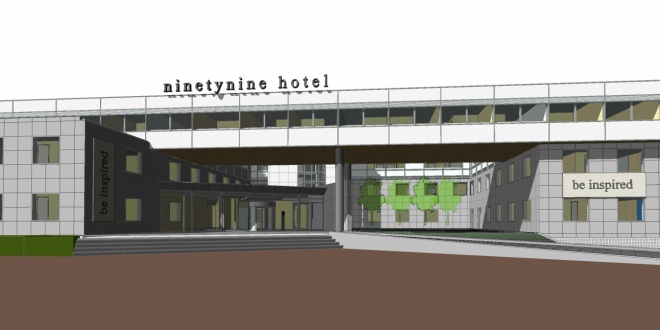
In 2016, we conducted a study on behalf of CTI (Control Towers International) into the possibilities of accommodating a hotel in an existing office building in Hoofddorp. The detached office building with parking garage at the Kruisweg 106 is part of the business park "de Hoek" in Hoofddorp. The building is a stone's throw from Schiphol and Amsterdam and is easily accessible by car and public transport.
We then made the design for the transformation into a hotel with 133 rooms and various facilities, such as a restaurant, bar and lounge.
Based on the study and design, the zoning plan has been adjusted in consultation with the municipality and an interested market party has been contracted: Centro Hotels from Germany. The design was then fully tailored to Centro's wishes. A completely new, trendy hotel formula for the Netherlands will be introduced in the building; the "Ninetynine-hotel Amsterdam", specifically aimed at the younger target group. Vitamin-E has provided the interior design of the Ninetynine formula on behalf of Centro. The new hotel will be a good addition to the current offer in the municipality of Haarlemmermeer.
The demolition work was carried out in 2017, and in November 2018 the transformation of the existing office building into a hotel started.
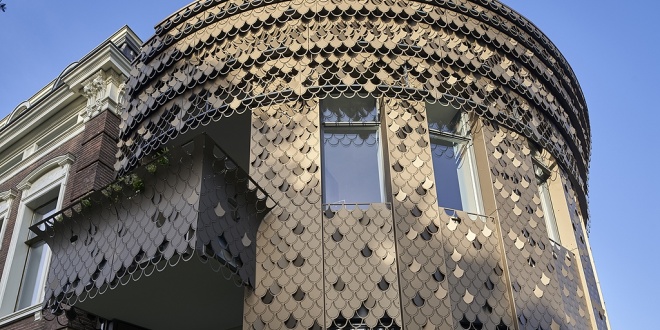
The Plantsoen in Leiden is well known for the historical appearance of both the city park (1836) and the houses of the last quarter of the 19th century. The park was originally landscaped on the edge of the city in the place of an old defense belt. At the entrance of the park at the east side the monumental building Plantsoen 1 – 3 is redeveloped in a complex with 6 apartments. The apartments of about 150 m² are provided with all luxury and comfort, such as a private indoor garage, spacious roof terraces and an elevator, while retaining the historical look and value of the building. Redevelopment also applies to sustainability; obtaining Energy label A. Exterior facades, window frames and roof are additionally insulated. The houses are underfloor heated and solar panels are provided on the roof.
The municipal monument at Plantsoen 1 – 3 is divided over three floors and a basement. The property at number 1 was originally a fully detached house, number 3 was part of a block of 3 houses. Both buildings date from 1875 and were connected in 1957 and converted into one large nursing home. In this function change, the original qualities have largely been lost. The round expansion at number 1 dates from 1993.
In the new layout with 6 apartment, the monuments are restored to their former glory by restoration contractor Burgy from Leiden. The façade of the intermediate building is renewed and aligned with the monuments. The existing façade of the round building is finished with a bronze wall cladding, a ‘veil‘ with a leaf motif. This pattern is inspired by the leaf motifs and decorations of the 19th century, which can still be found in various places along the Plantsoen. The round with ‘veil’ becomes a special recognition point in the inner city.
Each apartment has both rooms in the monumental area as well as in the newer parts. The interior of the monumental buildings is provided with appropriate details to bring back the historical character as much as possible. This specific part is provided by Verlaan & Bouwstra architects from Vianen.
On the inside buyers have a lot of freedom of choice; they can choose for an even richer historical finish with wall tension, panelling and en-suite layout or a tight, modern finish and layout; both are possible. Each apartment is unique, has its own layout and its own character. Only the view is the same for all apartments; they all look out over the beautiful monumental city park the Plantsoen at the town canal.
The redevelopment was completed in July 2018.
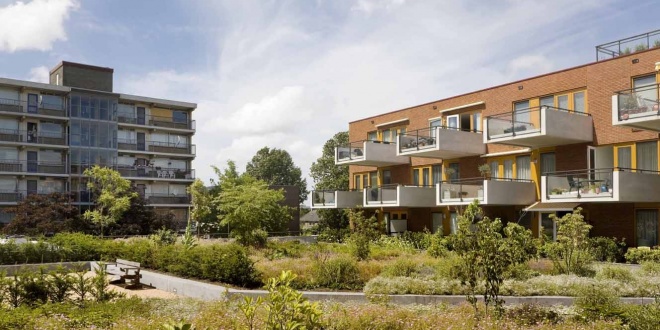
The “Meerwijk” district in Schalkwijk, built in the 1960s, has been built on the corner of Bernadottelaan and Albert Schweizerlaan. This center is part of the urban design that was made by our office in 2001. The building with retail spaces, including the Vomar supermarket, an underground parking garage with 215 places and 74 apartments, is one of the sub-plans of the community center. The whole has a modern, transparent and friendly character and adapts well to the neighborhood.