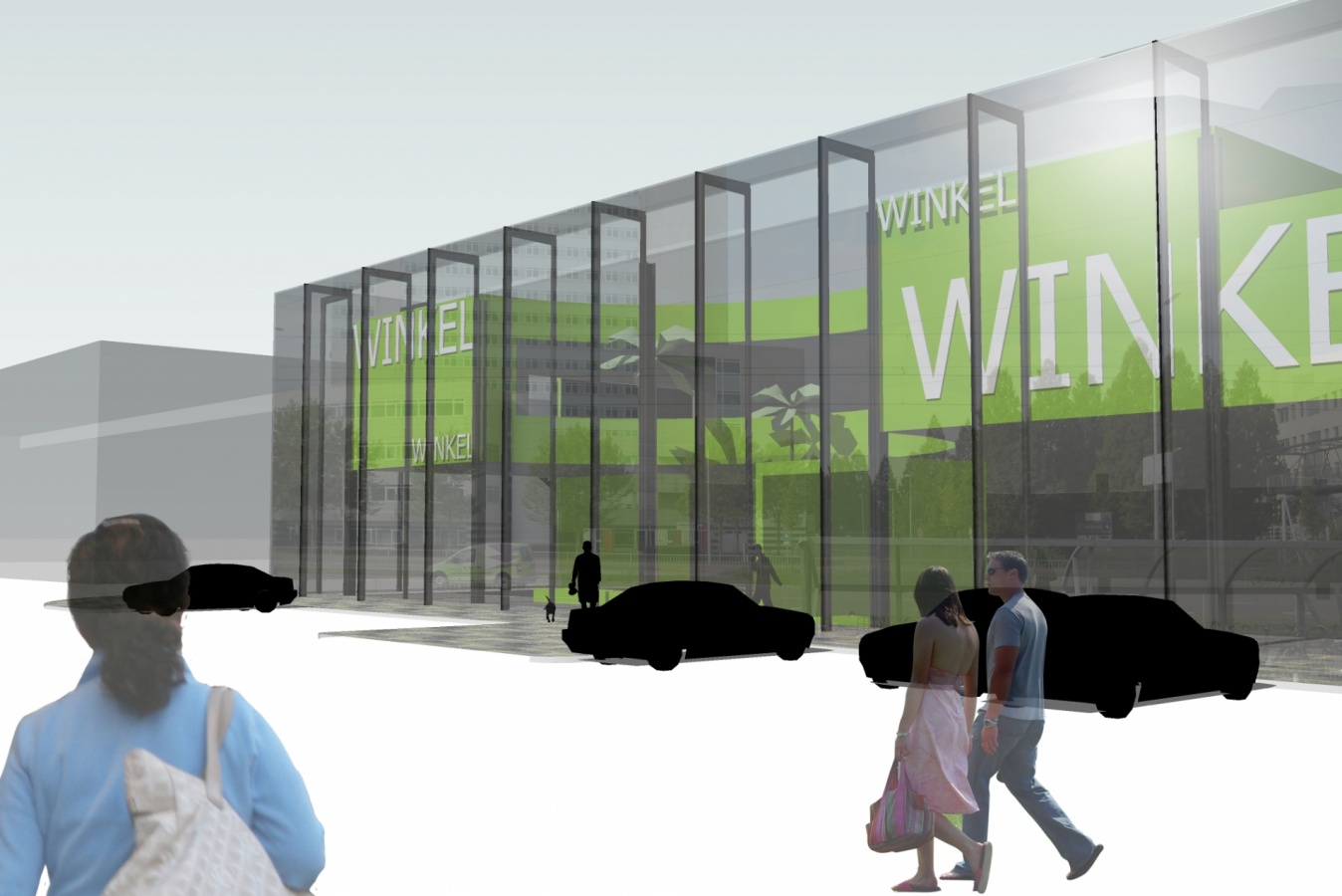
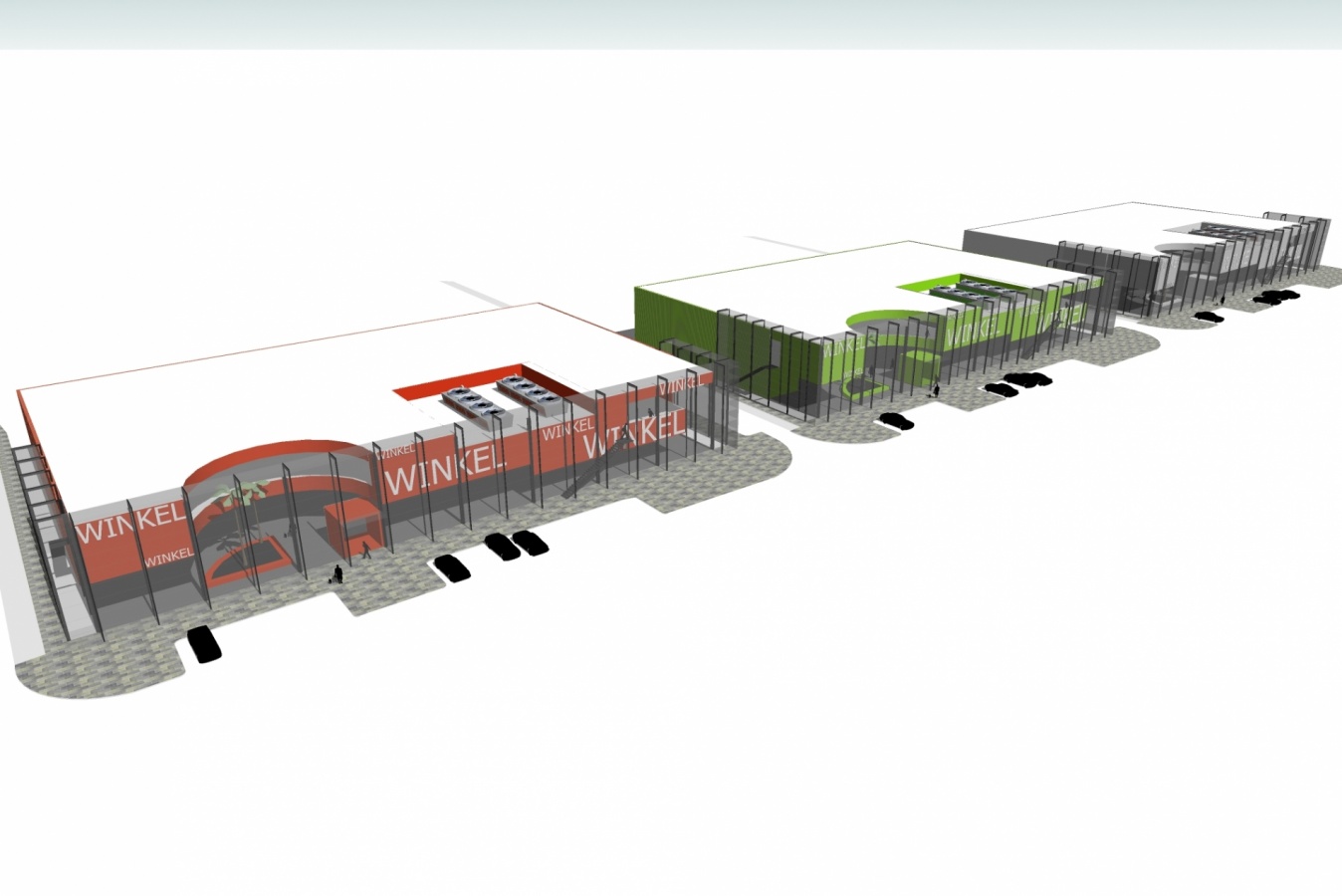
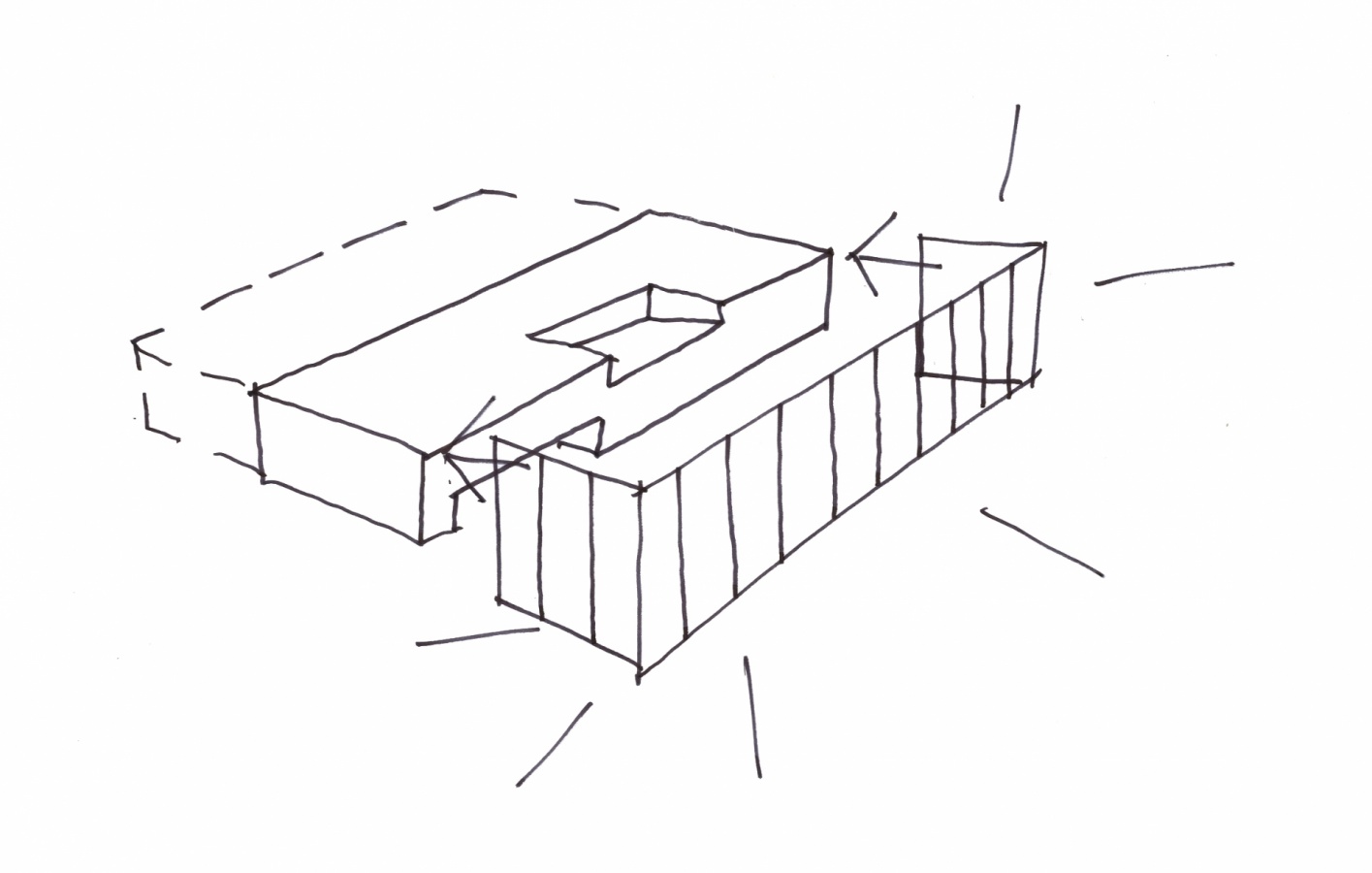
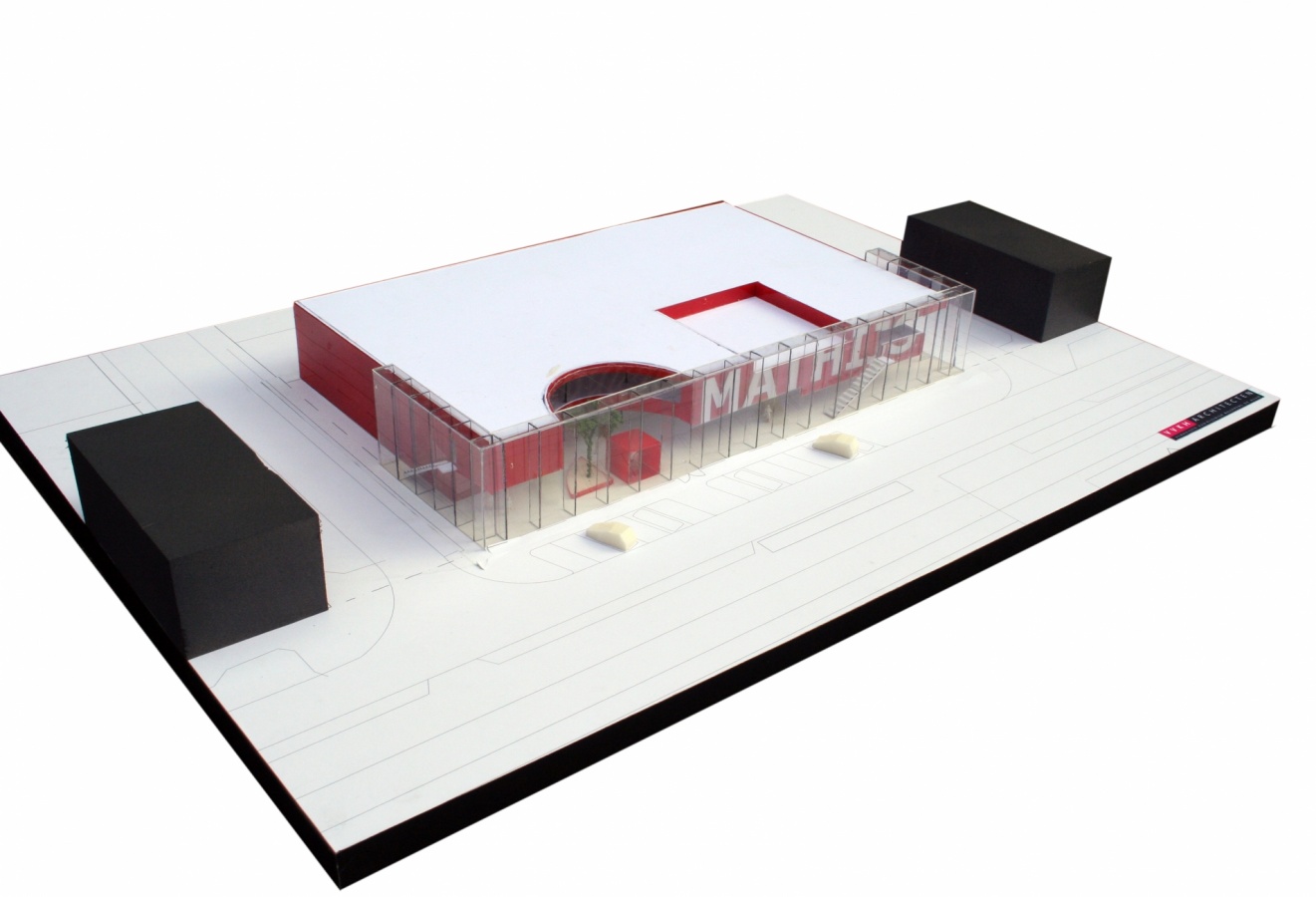
Commissioned by Bouwfonds REIM, VVKH has made a design for a distinguishable new shoppingbuilding. The new building is facing a main road entering Utrecht and acts as a showcase for the home and living stores in the streets behind. The plan consists of the demolition of an outdated officebuilding and construction of the new building with several shops showing a transparant facade towards the Europalaan.
| Architects | Gerrit-Jan van Rijswijk |
| Employees | Thomas Gillet |
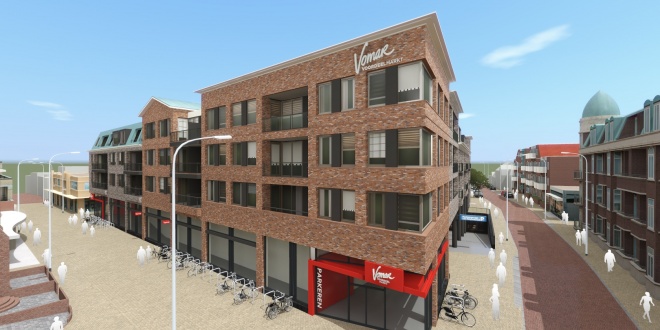
Urban development and architectural integration “Vomar” location, corner of Abraham van Rooijenstraat and Maarten Kruijtstraat in Noordwijk
From an urban planning point of view, the contours and height of the building plan were determined by the municipality of Noordwijk. The plan clearly defines the streets Abraham van Rooijenstraat and Maarten Kruijtstraat, in line with the existing street profiles. Gasthuissteeg will also have a clear boundary with this building plan.
The main mass has an intermediate scale between two worlds present in the environment. On the one hand, there is the smaller-scale village development of the Hoofdstraat and on the other hand, the large-scale hotel development. The mass of the new building block to be built is 3 storeys high plus a roof storey. It is articulated into a number of volumes, softening the scale of the building block. These volumes are made independent by different colors of masonry and roof finishes. With a play of rhythm between balconies, windows, tires, roof moldings and a green-copper-colored roof, the building blends in well with the seaside resort architecture of the environment. The mass on the Gasthuissteeg is 2 storeys high. It has a green facade with window openings. On the north side of the plan, the existing firebreak will be closed and the buildings will close directly on the adjacent plot.
The plan is mainly sustainable because of the triple land use. The building block has an underground floor, on top of that a storey layer, above that a parking deck for the houses and 42 houses.
Abraham van Rooijenstraat is an important access road. That is why functions such as the entrance to the underground parking garage, the entrance to the parking deck on the 1st floor in front of the houses, and the entrance to the expedition have been made here. The Kruisstraat will become more traffic-calmed. This will be the world of shopping as it is at the Hoofdstraat. This is where the shopping functions will be located, which are accessed via two clear entrances at the corners. These entrances are clearly visible from the Hoofdstraat and from the Grent.
The entrance to the houses is on the north side. This will give the existing loading and unloading yard, where other residential accesses are located, a quality impulse. The gallery facade, which is hardly visible from the public space, is conceived as a veranda world. It's a light world of painted wood.
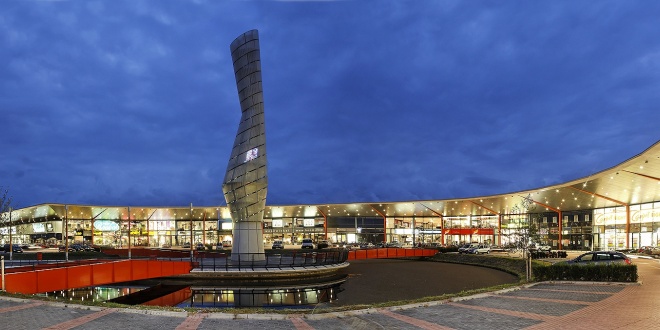
Cruquius Plaza, near Hoofddorp, municipality of Haarlemmermeer is the result of a competition that was organized in 1999 on behalf of the municipality of Haarlemmermeer to boost shopping in Cruquius. The competition was won by ING Vastgoed and VVKH. The existing residential boulevard has been completely renovated and adapted to the requirements of today. In addition, 30,000 m2 of retail space and 25,000 m2 of industrial space have been added. A flexible building, particularly with regard to the shops, and a water feature with a square at the shop entrances have been realized at the location. The cantilevered awning offers provides shelter for a pleasant shopping climate. The supply takes place from two expedition entrances on the company side. Via the internally located expedition corridors on the ground floor and first floor, the shops can be supplied freely from the shoppers. The 30-meter-high Cruquius Tower, the luminous center of the square, is a clear landmark of the residential boulevard.
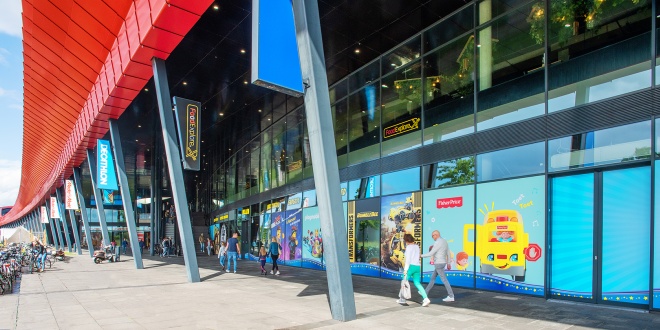
The Wall in motion
The Wall shopping center in Leidsche Rijn, located next to the A2, which also serves as a noise barrier, changed hands in 2018. Together with the new owners, real estate investors / developers Built to Build and Urban Interest, we have investigated parts that have not been implemented or have been incompletely completed and measures that are additionally needed to optimize the letting of the building. Since then, they have been working with them on perfecting both the building and the public space to make the shopping center a success.
The first steps for the Wall 2.0 have now been taken.
Since December 2018, a new AMAC location has been opened in the end building. We have made a number of allotment proposals and prepared various units in the end building based on the layout agreed with AMAC. The interior design was provided by Apple itself. In addition to a retail space, this location includes an auditorium, training room, service desk and repair center and warehouse / storage space in The Wall.
A number of improvements / changes that were implemented in 2019 and 2020 are an extra rise point to make the parking roof accessible from the adjacent office building, and an extra retail space on the deck. The entrance on the south side of the building has been adapted, with a tapis roulant and extra escalators. And on the north side of the building, an extra entrance, rising point and a roof building will be realized.
In addition, the possibilities for sustainability are being investigated by installing solar panels on the parking deck, making the parking deck greener and redesigning the ground level.
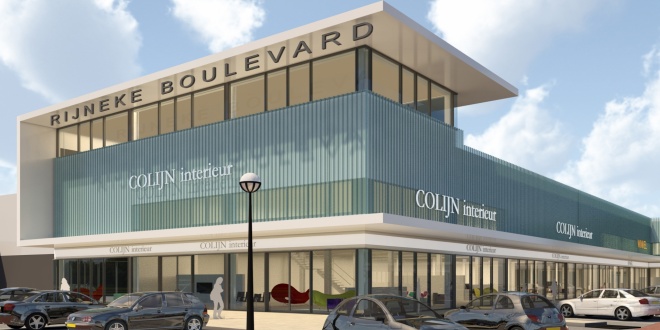
The Rijneke Boulevard in Zoeterwoude is a busy shopping area with a dated appearance. The complex has its back to the Rijn. We have developed a vision to renovate and expand the boulevard in stages. The Rijn is also more involved in the shopping area by creating harbors.
The first phase starts on the west side of the complex. In this phase, the first building has already been renovated (completed in 2016) and the expansion of 6,000 m2 of retail space started in January 2018. The shopping area is organized around the old harbor of the Heineken factory, where the hops used to be unloaded.